
Carroll County Value Types
Start with one question. Which Carroll County property value do you actually need? The assessor's assessment record, a recorded deed, and a private appraisal each answer something different. One drives the tax roll. One documents a past transfer. One estimates value for a stated purpose and date, and land and buildings may even appear as separate figures. The label, the year, and the source matter as much as the dollar amount itself. Any search Carroll County property value effort goes smoother when assessed, market, sale, and taxable values stay distinct.
| Value Type | What the Number Means | Record to Check |
|---|---|---|
| Assessed value | The statutory portion of county fair market value used in the tax system | Board of Tax Assessors roll and land book |
| Fair market value | The county's January 1 mass-appraisal estimate before the general assessment ratio | Assessor property record or notice |
| Last sale price | The amount tied to a past conveyance when consideration data is shown | Recorded deed, PT-61, or populated sale history |
| Private appraised value | An appraiser's opinion for a stated purpose and effective date | Private appraisal report, not the public tax roll |
Exemptions and preferential programs can push taxable value even lower. That number exists to produce a tax bill, not to predict a sale price. Keeping the labels straight avoids the most common Carroll County property value mistake.
Carroll County's 40 Percent Rule
The Carroll Tax Commissioner puts it plainly. Taxable assessed value equals 40 percent of fair market value. Picture 100 units of fair market value. The general assessed figure would be 40 units before exemptions or special treatment. Never compare an assessed value dollar for dollar with an asking price. That ratio is the reason. Georgia also runs property-specific programs. Carroll applies a 30 percent assessment to qualifying bona fide agricultural land. Conservation Use values qualifying agricultural, timber, environmentally sensitive, or residential-transitional property at its current use. Forest-land rules carry their own conditions. Each program shifts the assessment basis, never the historical amount recorded in a deed.
Note: Confirm program status with the Board of Tax Assessors; a land-use label alone does not establish eligibility.
January 1 Sets Carroll Value
Carroll County pegs fair market value to January 1 every year. That is a valuation date. The displayed figure does not chase every market swing afterward. A spring sale can fall outside the annual snapshot. A late-year renovation can too. So can a sudden demand shift. A recorded sale can also land above or below the next January 1 figure. Parties may have transferred only a partial interest. They may have bundled multiple tracts. Or they may have agreed to terms a bare consideration amount hides. The assessor runs a countywide valuation process; two individuals set one transaction price. Carry the date and context with every Carroll County assessed value.
Locate Carroll County Assessed Value
The Carroll County qPublic portal is the official assessor search route. Address, owner, and map or parcel number search are the supported entry points. Open the portal directly and read the parcel card's own value labels and years before citing anything.
- Search the situs address. If formatting fails, try the street name and common suffix variants, or begin with the parcel number from GIS or the tax search.
- Match the result with map number, record number, district, acreage, legal description, subdivision, and lot. Do not choose by owner name alone.
- Read the year and each labeled amount. Keep land, improvements, total reassessed value, fair market value, and assessed value in separate fields.
- For a sale comparison, record the deed date and book/page, then verify any visible consideration through the Clerk or GSCCCA.
- Fair market value
- The county's January 1 estimate of the property's full value for assessment administration.
- Assessed value
- The value produced by applying the governing assessment level to fair market value.
- Assessment ratio
- The percentage relationship between fair market value and assessed value, generally 40 percent here.
- Consideration
- The amount or value stated in connection with a transfer; it may need context before being treated as a sale price.
- Reassessment
- An update to the county's property valuation for an assessment year.
Carroll County Value Search Source
The official Carroll County assessor portal is the right public system to start from. Confirm the source first. Then read the record's value labels and assessment year.
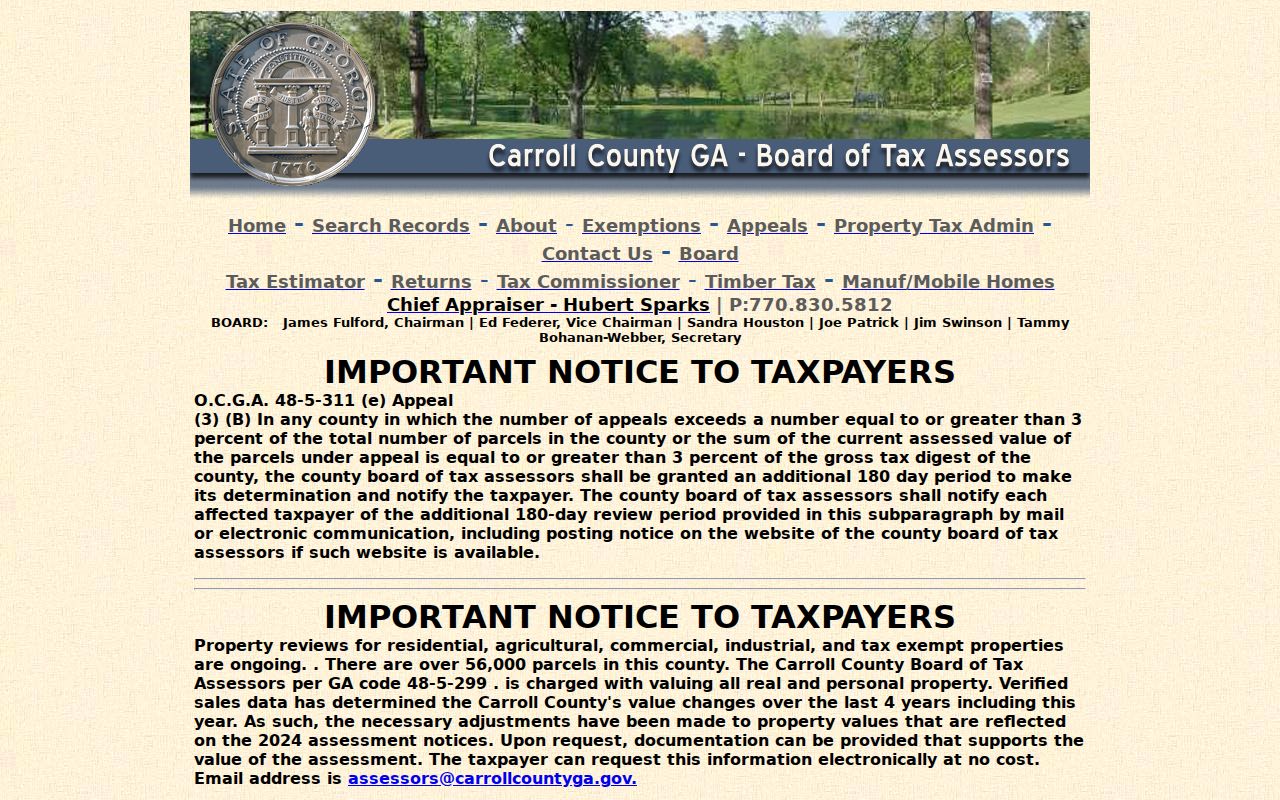
Naming the source is only step one. The portal is no substitute for opening the current parcel card itself. Save the parcel key and assessment year with any figure you cite.
Carroll's 2025 Value Fields
Carroll's 2025 General Reassessment Land Book shows exactly what local records contain. It publishes owner, map number, record number, district, acreage, reassessed land value, reassessed improvement value, and total reassessed value. That field inventory helps confirm what each amount represents on a parcel.
| Land | The assessed component assigned to the site itself |
|---|---|
| Improvements | The component assigned to buildings or other taxable improvements |
| Total | The combined reassessed amount shown in the land book |
| Year | The assessment period needed to compare records correctly |
Splitting land from improvements gives useful structure for a Carroll County property value review. It cannot show the method, condition judgment, or comparable set behind the mass appraisal. Ask the assessor when the component split itself is the question.
Carroll Sale Price Is Historical
The GSCCCA Real Estate Index links an owner name to recording date and instrument. It also returns book/page and related images. PT-61 tools also support transfer research, including premium address or map search. A sale or consideration figure, when visible, describes that one recorded event. It is not a current estimate. Confirm the deed covers the same parcel. Match the legal description, subdivision and lot, map reference, acreage, and book/page. Do not trust a street address alone. Correction deeds, family transfers, estate instruments, tax deeds, and multi-parcel deals can all distort a raw amount. Such an amount may be poor evidence of market price. When consideration is absent from the record, mark it absent instead of estimating.
Why Carroll Values Diverge
Time is one reason values diverge. The assessor anchors to January 1. A sale carries its own deed and recording dates. Purpose is another. Mass appraisal supports uniform county assessment. A private appraisal serves a particular assignment. A transaction reflects terms two parties accepted. Scope differs too. The assessor card may track one parcel. A deed transfers several tracts or a partial interest. Preferential valuation can change the roll basis. Exemptions can change a taxable amount without touching fair market value. Improvements may not appear until a later year. Compare like fields, like parcels, and like dates before concluding anything.
Note: A number can be official and still answer a different question from the one a buyer is asking.
Compare Carroll County Value Records
A tidy worksheet keeps unlike numbers from blurring together. Give the January 1 fair market figure its own line. List assessed land and assessed improvements separately. Then the total assessed value gets its own line. Note the assessment year and any verified preferential program. Recorded consideration, deed date, and book/page belong in separate historical columns.
Label each entry clearly. Call it an official field, a calculated amount, or a historical transaction. Or call it simply absent from the source. Never back-calculate a fair market figure and pass it off as a portal result. A deed amount is not the current Carroll County property value. The worksheet works best a specific way. It preserves exactly what the county published and what it did not.
Carroll Value Record Fallbacks
When qPublic is down, the published land book can confirm the official field set. The land book shows the fields for its year. The Board of Tax Assessors will discuss parcel valuation in person. The office sits at 423 College Street, Room 415. You can also call 770-830-5812. For deed consideration or book/page questions, try the Carroll County Clerk's Real Estate division. You can also try GSCCCA.
The Tax Commissioner portal can help you locate a parcel. It also shows the assessed figures used for billing. Still, a tax bill is not a market-value report. Billing details, exemptions, and appeals are covered under Carroll County property tax records. An open-records request works as a fallback for documents the county already holds. It cannot force the county to produce a new valuation or appraisal.
Carroll Property Value Limits
An assessor's number supports public administration through mass appraisal. It cannot capture every fact a buyer, owner, appraiser, or title professional might need later. The county card does not prove title. Nor does it prove legal access, boundary location, structural condition, or the price another party would accept.
Need a current opinion? Hire a Georgia licensed appraiser and state the purpose and effective date. For ownership, examine the recorded deed and the title evidence behind it. For boundaries, rely on recorded plats, deed descriptions, monuments, and a licensed surveyor. Keep these tasks separate. That leaves the Carroll County assessed value with the limited, useful meaning it was built to carry.
Value is not price. A Carroll County assessed value is for the tax system. It is neither a sale promise nor a private appraisal.