
Reconstruct Carroll County Former Owners
A backward deed timeline starts from one known current conveyance and lists one transfer per row. Each grantor becomes the next earlier grantee to search. The rows are a worksheet, not parcel facts. Pull every date and reference from the Carroll County deeds themselves.
| Transfer date | Grantor to grantee | Deed type | Book and page |
|---|---|---|---|
| Newest matching date | Seller named in current deed to current grantee | Record the indexed instrument | Copy exact citation |
| Next earlier date | That seller's seller to that seller | Record warranty, quitclaim, tax, or estate deed | Copy exact citation |
| Repeat backward | Prior grantor to prior grantee | Note any correction or special transfer | Copy exact citation |
| Historic-book era | Indexed former owner to earlier grantee | Read original book entry | Preserve volume and page |
Not every name change is an ordinary sale. Quitclaim deeds, executor deeds, tax deeds, sheriff's deeds, and probate orders can break a tidy seller-to-buyer pattern. Correction deeds shift descriptions too. The land description is the constant that tells you whether a row belongs in the same chain.
Go Back Through Carroll Deeds
The GSCCCA Real Estate Name Search is the modern starting point for Carroll County deeds. The central index begins at 1990. A separate Carroll property-search dataset reaches back to 1987. GSCCCA describes its standardized consolidated system as starting no earlier than 1999. Those are three different dates for three different things. None marks the beginning of Carroll County land recording. Search by party role and exact name. Narrow the date range when a common name creates noise. A result can show indexed parties, instrument type, recording date, location, and book-page data. Images may require an account, and printed pages carry GSCCCA's documented charge. The Clerk's original index controls if a reconstructed online entry conflicts. Open the official name-search form for the backward chain:
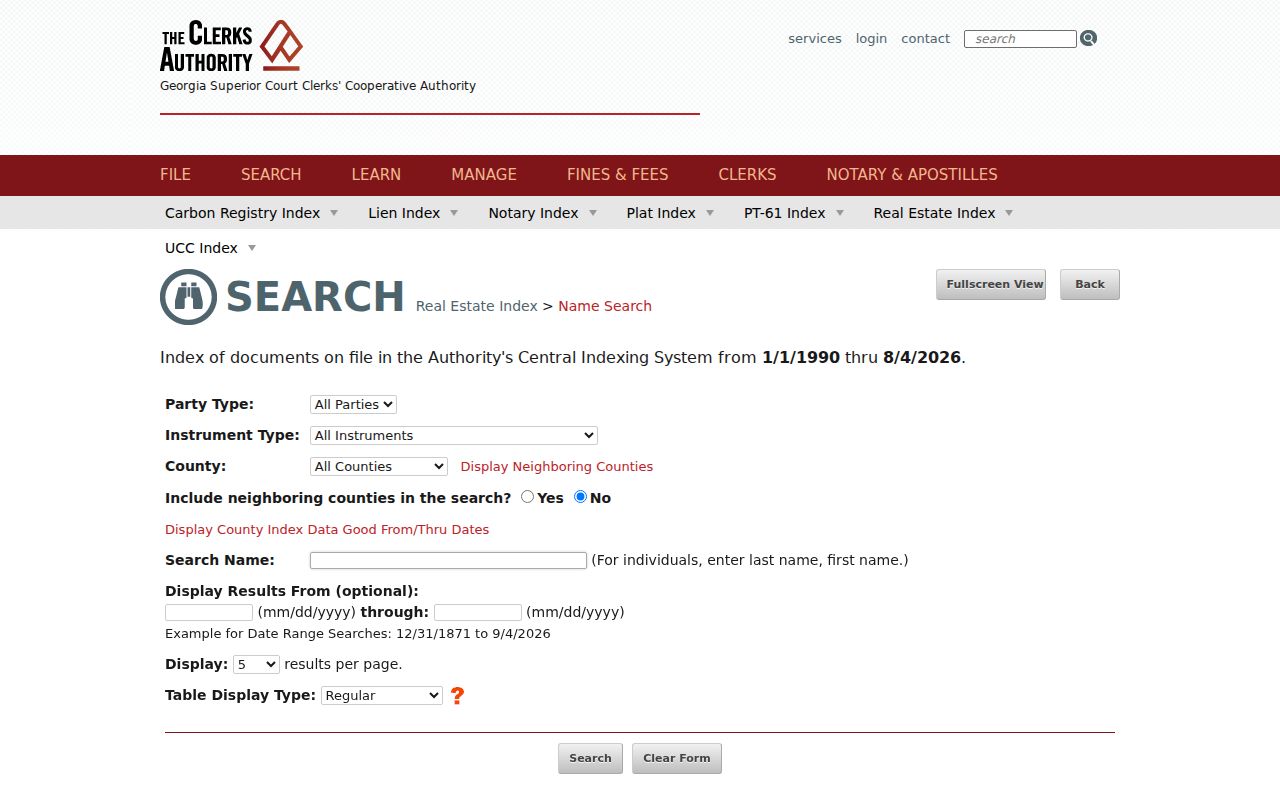
The party, county, instrument, and date controls are visible. Each former grantor becomes an earlier grantee search with a few entries.
Walk Carroll County's Chain Backward
Begin with the newest deed matching the parcel. The grantee holds the interest. The grantor is the former owner, and that name becomes the next search; the walk holds only while the description stays consistent.
- Find the current owner's acquisition deed by searching that owner as grantee.
- Record its grantor, date, instrument type, book and page, and full legal description.
- Search that grantor as a grantee in an earlier period. Match subdivision, lot and block, land lot and district, acreage, or prior reference.
- Repeat until an estate, tax deed, name variant, index cutoff, or description change requires another source.
- Grantor
- The party transferring the recorded interest.
- Grantee
- The party receiving the recorded interest.
- Chain of title
- The ordered series of instruments affecting the same land.
- Reverse index
- An index route used to find a former owner's acquisition before that owner conveyed the land.
- Quitclaim and warranty deeds
- Different deed forms that require reading the instrument; the index label alone does not state the quality of title.
Note: A repeated surname is not enough; every former-owner link needs a matching Carroll County legal description or parcel reference.
Bridge Carroll's Historic Owner Index
Carroll County offers a specific bridge into early records. The Kofile historic land index covers 1828 through 1965. Its controls include Type, Year, Parties, Last Name, and First Name. It runs around the clock. The portal points deed images toward GSCCCA. The Carroll County Genealogical Society reports deed books imaged from current records back to February 1950. Those ranges overlap, but they are not identical. Use the Kofile entry to find the party and book reference. Then check the matching image series or courthouse volume, and when a chain crosses 1965, work backward from GSCCCA into Kofile rather than assuming one search covers both eras. Open the Carroll historic index source shown here:
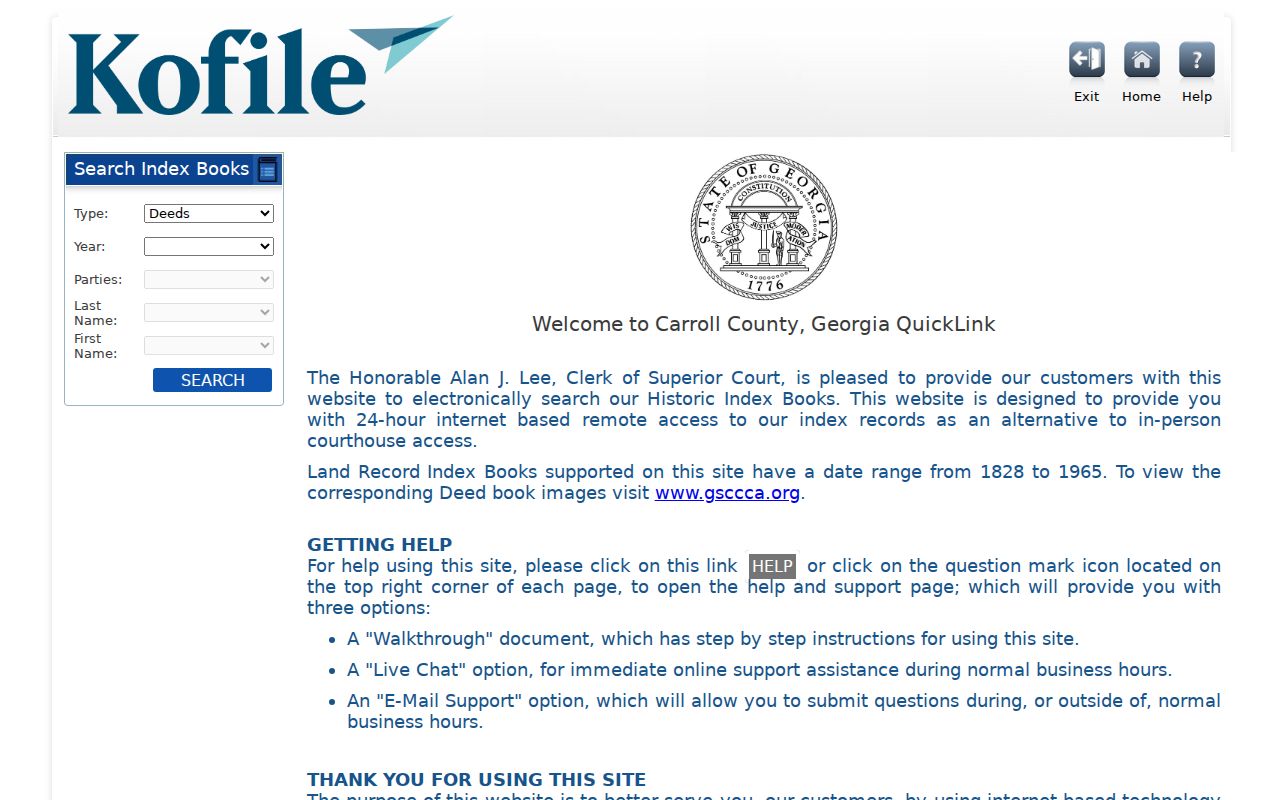
The historic portal shown here opens the older deed books through its separate index controls.
Coverage limit. The remote historic index ends in 1965. Earlier and overlapping former-owner work may require deed books, microfilm, GSCCCA images, and the Clerk's counter.
Follow Carroll County Plat References
A name-only chain can fail. Tracts get split, merged, or replatted. Older papers may describe land by subdivision rather than street. A recorded plat can supply the subdivision name, lot, block, streets, easements, acreage, survey certification, and its own book-page reference. It can also supply its own book-page reference. Carroll County's parcel sheet tracks map, land lot, parcel, district, subdivision, lot, acreage, and parcel-split-from fields. It also tracks parcel-split-from fields. Carry those identifiers into each old deed. The county subdivision and parcel-split resources explain the local plat setting. GSCCCA offers plat index routes. A modern GIS polygon helps orient the tract. It is no survey and cannot replace recorded dimensions.
Reconnect Carroll County Estate Transfers
A deceased owner may leave no purchase deed. Check Carroll Probate Court for the estate, executor or administrator, heirs, and property-related orders. Then return to the real-estate index. Look for an executor's deed, administrator's deed, assent, deed of distribution, affidavit, or family settlement that was actually recorded. Tax deeds and sheriff's deeds can redirect the sequence too. A tax-sale notice may combine map and parcel number, record holder, tax defendant, tax year, deed book-page, and plat reference. Treat it as a lead, not the final chain. Confirm the later recorded instrument and its land description.
Note: An obituary can suggest an estate name and date, but it is not a conveyance or proof of prior ownership.
Check Carroll's Courthouse Fire Trail
Carroll County's 1880s brick courthouse burned in 1927. The present courthouse went up in 1928. Georgia Archives materials use a 1928 disaster reference, likely reflecting the fire-versus-replacement distinction. That gap does not mean every deed book burned. The surviving 1828-to-1965 historic index is exactly why the real record group must be checked. When a former-owner link vanishes near that era, compare the Clerk's historic index, courthouse volumes, microfilm finding aids, and Georgia Archives guidance. Two local helpers exist. The Carroll County Genealogical Society and Neva Lomason Library can track down local history or newspaper leads. The chain still needs a deed or probate order.
Reach Carroll County's Earliest Owners
The online historic index for Carroll County reaches back to 1828. That sits close to the county's creation in 1826 and the land-lottery era. Treat that year as the practical floor. It is not a guarantee that every earlier owner of record can be named from a single database. Legal descriptions from that period often turn on land lots and districts. Those tend to survive better than modern street labels. If an address search stalls, work the historic subdivision instead. Try the prior street name, the legal description, or a recorded book reference.
For official books and entries the online index cannot settle, the courthouse counter remains the access channel. The Georgia Archives can point you toward microfilm and record groups. Its Ask an Archivist service is a fair fallback. It does not hold every Carroll County deed, though. A precise Open Records Act request can also ask a custodian for an existing index or file. For the mechanics of pulling a single instrument, the Carroll County deed records resource covers the copy options.
Lawful use. Former-owner research supports house history, estate work, and land diligence. Never use a historic chain to stalk, harass, or harm a living person.