
Decode Carroll Property Tax Records
Carroll property tax records draw on two jobs. The Board of Tax Assessors identifies and values taxable parcels. The Tax Commissioner bills, collects, and runs delinquency and tax-sale work. An assessment card explains how the value was set. A bill shows the rate applied and any exemptions credited. Neither record tells the whole story. Read both together. A paid bill proves nothing about valuation, and an assessment card proves nothing about payment.
| Field | What It Shows | Where |
|---|---|---|
| Fair market value | County estimate as of January 1 | Board of Tax Assessors record |
| Assessed value | Taxable assessment level before later bill calculations | Board of Tax Assessors record |
| Land and improvements | Separate value components and their total | qPublic card and land book |
| Exemption or program | Qualifying tax treatment tied to the parcel | Assessor record and notice |
| Bill and payment status | Tax year, amount, payment, or delinquency | Tax Commissioner portal |
Carroll County pegs assessments at 40 percent of fair market value each January 1. The tax bill grows out of that assessed figure. The local millage rate then sets the rest. Exemptions adjust whatever the parcel qualifies for. A deed records one sale at one point in time. Its price says nothing about what the property would fetch today.
Carroll Tax Offices Have Separate Roles
The Carroll County Board of Tax Assessors keeps the owner-of-record roll, parcel and map numbers, land and improvement values, acreage, property characteristics, exemptions, notices, and appeals. The office sits at 423 College Street, Room 415, in Carrollton. Its published phone is 770-830-5812. Public searching runs through qPublic.
The Tax Commissioner handles the money side. That office, at 423 College Street, holds bills, payments, delinquencies, tax-sale information, and excess-funds material. The listed phones are 770-830-5826 or 770-830-5843. A 2026 notice says the office moves back there on May 18, closing May 18 through 20 for the transition, so confirm before a visit. Regular hours are weekdays, 8 a.m. to 5 p.m.
Carroll's Forty Percent Tax Rule
The Tax Commissioner's general information page sets the sequence. Fair market value is fixed each January 1. Assessed value is 40 percent of that figure. Then the millage rate applies. That order explains why market value, assessed value, and the final tax differ even though they relate.
Carroll's 2025 General Reassessment Land Book makes the parts visible. Fields include owner, map number, record number, district, acreage, and reassessed land, improvement, and total values. Comparing land against buildings can show what changed. The record number and map number keep the right parcel in view.
Note: A January 1 tax value is a statutory assessment point, not a live offer, private appraisal, or title finding.
The land book helps you compare years safely. Keep owner, map number, record number, district, and acreage beside the land, improvement, and total values. A change in the total may come from land, structures, or both. Watch the acreage too. If acreage shifted, suspect a parcel split first. Each field carries weight. The assessment record shows the base behind Carroll County property tax, but it never shows whether the resulting bill was paid.
Search Carroll Tax Bills Precisely
The Carroll property-tax search offers a tax-year control plus six search modes. Start with address or parcel when the land is known. Names deserve care. Common names and business variations can return several accounts. Keep leading zeros intact. Keep letter prefixes in parcel identifiers intact too.
| Portal field | Best use | Check before relying |
|---|---|---|
| Tax Year | Choose the bill period | Current and prior years can differ |
| Name | Find an owner-indexed account | Confirm the parcel and address |
| Bill | Return a known bill | Copy all digits |
| Company | Search a business-name account | Use the exact legal name |
| Parcel or Account | Target the county identifier | Keep zeros and prefixes |
| Address | Start from the physical site | Try street variants if needed |
The official AssuranceWeb tax form lays out every search field for Carroll County property tax records in one place.
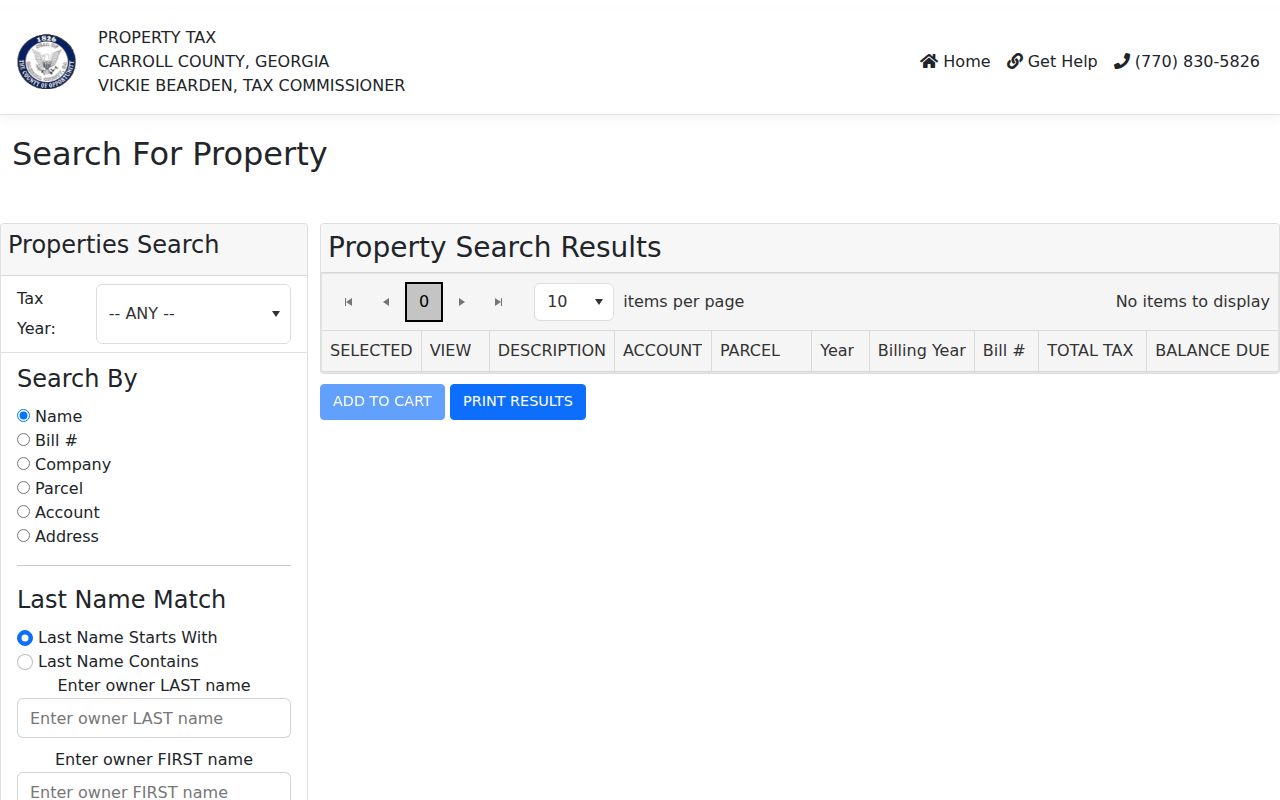
The page makes one thing plain: the tax bill search reaches beyond a simple address box and welcomes a parcel-first approach.
Look Up a Carroll Tax Bill
Start with identity, not the amount. A parcel number is the cleanest key to any Carroll County tax bill. When the address is fuzzy, pin down the parcel first. Use qPublic or the GIS map for that. Then take that parcel, pick the tax year, and search it in AssuranceWeb. Before trusting any payment status, confirm the owner of record, account, and site address. All three should line up. One caution: an older delinquency can live on its own. It may sit separate from the current bill you are viewing.
- Choose the correct tax year and search by exact parcel or account number when possible.
- Match the returned owner and address, then read the bill amount and payment status.
- Open the assessor record to check fair market value, assessed value, and any listed program.
- For an unpaid account, review the official delinquency and tax-sale channels, then call the Tax Commissioner for current status.
- Assessed value
- The value to which the tax calculation is applied before relevant adjustments.
- Millage rate
- The rate used with assessed value to calculate tax.
- Homestead exemption
- Qualifying tax relief associated with an owner-occupied home.
- Tax lien
- A government claim arising from unpaid property tax.
Sometimes the portal leaves a question open. In that case, go straight to the Tax Commissioner by phone or at the counter. Carroll County also takes open-records requests by phone, fax, email, mail, and drop-off, though a direct account inquiry with the office usually answers faster.
Carroll Assessment Programs Change Taxable Value
Carroll County grants several forms of preferential treatment on taxable value. Bona fide agricultural property that qualifies is assessed at 30 percent of value. Conservation Use works differently. It values qualifying agricultural, timber, environmentally sensitive, or residential-transitional land at current use. Market value is not the measure. The county notes a ten-year covenant usually applies. Forest land carries its own terms. Qualifying tracts over 200 acres held by eligible owners fall under a fifteen-year covenant.
None of this happens automatically. Eligibility turns on application, use, acreage, ownership, and covenant rules. A breach can carry real consequences. Ask the Board of Tax Assessors which program sits on the parcel. Ask also what records the office requires. For the meaning of the value fields themselves, look to the Carroll County property value page. It keeps the three number types separate.
Read the program name and year as closely as the figures. Two similar tracts can show different taxable figures. Their market-value context may look alike even so. Carroll's published materials describe the 30 percent agricultural level. They also describe Conservation Use for specified land uses. Forest-land rules for tracts over 200 acres stand separate. The official application and covenant control. A portal flag alone does not make a new owner eligible.
Carroll Delinquency and Tax Sales
The Carroll tax-sale page posts sale information and excess-funds material. Opening bids include taxes, penalties, and costs. The auction is public. Afterward the levy officer records a sheriff's tax deed. That deed is not fee-simple title. Buyers must investigate title themselves. During the stated redemption period, the buyer cannot take possession or trespass on the property.
A March 2025 legal notice shows the cross-record detail in this channel. It lists map and parcel, current record holder, fi-fa defendant, amount due, tax years, deed book and page, legal description, and a plat reference. Treat the notice as a dated lead. Confirm the latest bill, current sale status, deed record, and any redemption filing before acting.
Note: Carroll County publishes no separate foreclosure-sale calendar; tax sales and court foreclosures follow different trails.
Get Carroll Tax Records Offline
In Carroll County, the counter and phone still matter. The assessor handles the valuation record and notice. The Tax Commissioner takes questions about a bill, payment, delinquency, or tax sale. Bring the tax year, owner name, site address, parcel or map number, and account or bill number when you have them.
Some documents sit outside those portals. For those, the Carroll open-records process accepts requests through several channels. The first 15 minutes and 20 pages are free. Beyond that, the price is $0.10 per page. Allowed staff time gets added too. Georgia's Open Records Act generally requires production within three business days, or a written timetable, cost, and exemption explanation; the agency need not create a new report.
Appeal a Carroll County Assessment
An appeal contests the assessor's notice, not the Tax Commissioner's arithmetic. Carroll County posts a program and appeals route. An appeal flow summary sits alongside it. The clock matters. Filers have 45 days from the date on the assessment notice. The county requires mailing or hand delivery; email and fax do not count.
A good filing names the parcel, the disputed value or issue, and the review path wanted. Proof can include a recent arm's-length sale, comparable sales, a current appraisal, photos, repair evidence, a corrected property description, or uniformity evidence from similar parcels. Board of Equalization, hearing-officer, arbitration, and Superior Court routes each have their own rules and timing. Use the official form. Follow the current instructions.
Appeal window. File with the Carroll County Board of Tax Assessors within 45 days of the notice date by an accepted delivery method.
Keep a dated copy and proof of delivery. An informal chat with staff can clarify a field. It never replaces a timely appeal, and the notice plus the county summary control the next step.